
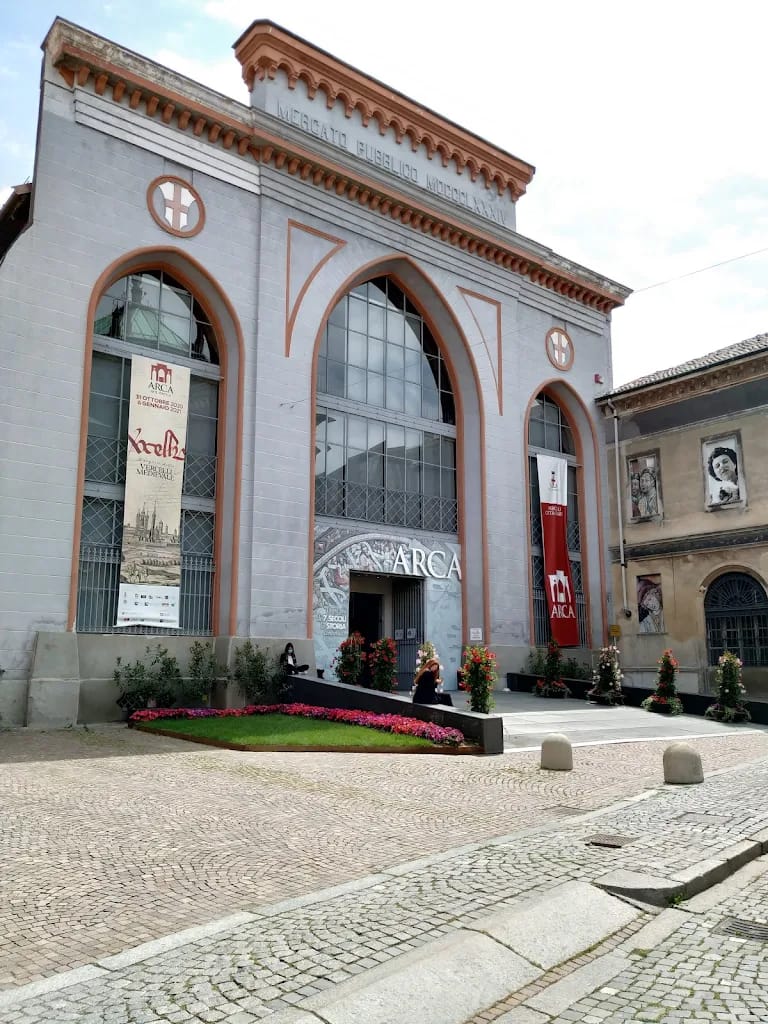
An artistic novelty will characterize September in Vercelli and the months to follow. From 11 September 2025 to 11 January 2026 in Vercelli, in the church of San Marco, in the Spazio Arca, the exhibition entitled “Guttuso, De Pisis, Fontana... Italian Expressionism” will be set up. This is the inauguration of a five-year exhibition project born from the
collaboration between Arca Arte Vercelli and the Giuseppe Iannaccone Foundation.
The exhibition will feature 34 works created between 1920 and 1945, belonging to the historical core of the Giuseppe Iannaccone Collection, which will be included in a single exhibition itinerary.
The artists on display include Renato Guttuso, Renato Birolli, Lucio Fontana, Fausto Pirandello, Aligi Sassu, Alberto Ziveri, and Emilio Vedova, who distinguished themselves by maintaining an expressive autonomy.
The exhibition will be a unique opportunity to admire masterpieces of rare intensity and historical-artistic value, some of which have never been exhibited to the public.
The event, strongly supported by Vercelli's mayor, Roberto Scheda, celebrates this highly topical period in the history of 20th-century Italian art. The exhibition is curated by Daniele Fenaroli, general director of the Giuseppe Iannacone Foundation, in partnership with Arthemisia, sponsored by the Cassa di Risparmio di Vercelli Foundation, the Province, and ASM.
"Through vibrant colors and irregular shapes, these works depict a fragile, disjointed Italy, riddled with tension and loneliness, driven by a powerful need for truth and authenticity," explains Fenaroli. "Far from celebratory aesthetics and official propaganda, Italian Expressionism asserts itself as a profound, humane counter-narrative, capable of restoring the individual's dignity, anguish, and disorientation. It is precisely in this dimension that Italian Expressionist painting becomes an "emotional excavation and empathy, capable of transcending appearances to penetrate the heart of human experience."
In a historical context in which art was often used as a tool of control and standardization, these artists were able to give voice to dissent, ambiguity, and fragility, leaving behind a visual legacy of rare power.
The installation is designed to dialogue harmoniously with the Arca space and
will accompany the visitor on an immersive journey in which light, space and silence
enhance the expressive power of the works.
Among the works on display, some emblematic works of Italian Expressionism stand out, such as “Standing Nude” by Lucio Fontana from 1939, “Composition (Siesta Rustica)” by Fausto Pirandello (1924-1926), “Caffeuccio veneziano” by Emilio Vedova from 42, “Schermidor” by Angelo del Bon from 1934 and “Portrait of Antonino Santangelo” by Renato Guttuso from 1942.
The collaborative project aims to create a multidisciplinary dialogue, starting from the intertwining of works from the Giuseppe Iannaccone Collection with those of a young emerging artist and with the space of the former Church of San Marco degli Eremiti.
In this first edition, the great Italian art of the early twentieth century will be accompanied by three works by the young artist Norberto Spina, from Milan (1995), including a loan from the Royal Academy in London and previously unpublished site-specific works, conceived for the occasion.
The artist shows an approach inspired by a rereading of history, suggesting at the same time
same continuity in the way in which art can offer a personal vision of reality.
Spina, like the artists of the 1930s who rejected the celebratory aesthetic of power, also operates on the margins of collective memory, reinterpreting atmospheres, gestures, and faces and bringing them to light without indulging in nostalgia, but through a conscious act. Spina invites the viewer not to remain a passive observer before the intense faces of Benito Albino Dassler, Mussolini's unrecognized son, and that of Edda Ciano.
The artist explores the ways in which the image of power is reflected in our contemporary gaze. His is an invitation to view history not as a closed archive, but as a living and complex organism, riddled with ever-present tensions.
There are works by Norberto Spina that establish a dialogue with the past, among these "The Battle of the Three Knights" by Aligi Sassu from 1941, placed next to 'Presente' by Norberto Spina from 2024, which reworks a detail of the Redipuglia Shrine, built by Mussolini in 1938. Sassu, in the aftermath of his imprisonment, in the midst of the world conflict, relies on a
An epic painting denouncing an absurd war, Spina, with a minimalist language, isolates a word in stone to confront it with our own time. On the one hand, the knights' bodies clearly express the loss of the individual, the annihilation of the human spirit; on the other, the power expressed through a silent monumentality continues to question the visitor.